
Welcome to In the Weeds, a publication for celebrating and commiserating about independent restaurant life. Today, we're discussing influencers, anti-influencers, and using social media for good.
If this email was forwarded to you, you can subscribe here.

TikTok screengrabs and an interior shot of Markette, credit: Natalie Black
Like many restaurant owners, India Doris is fed up with influencers. Recently, the chef and owner of Markette in Manhattan got strung along for about a week before the influencer she was speaking to demanded $5,000 for a story.
“When I refused to pay the money, they kept bargaining with me,” she said in a phone call a few weeks ago.
Although India and co-owner Alex Pfaffenbach have worked for restaurant groups (Kent, Quality Branded, etc.), Markette, which opened last year, isn’t part of one. To open the restaurant, “I put my life on the line,” she said. “I can’t afford to pay influencers.”
Instead, she reached out to Jay, a small-business owner and anti-influencer of sorts. Founder of Daadi Snacks, Jay, who doesn't disclose his last name, uses the company's social media to call out questionable moves by other online creators, like unwarranted negative reviews. He was inspired to start these posts after his own negative experience with influencers, he told Food and Wine.
India, who recently won the Michelin Guide Northeast Cities Young Chef Award, had been a fan of Jay’s for a while.
Jay visited Markette last month. In his post about the restaurant, he explains India’s influencer troubles, and her concerns about getting the word out about her restaurant, before jumping into a glowing review of her Caribbean- and European-influenced menu.
@daadisnacks happy Black History Month! support @marketterestaurant #nyc #nycfood
The post blew up. Two million views on TikTok, another two million on Instagram. India’s comment thanking Daadi got over 35,000 likes. Anecdotally, my Pilates instructor in Ohio sent me the post.
But do all those likes, views, and shares bring in diners? They do, India said. “Hats off to him. What [Jay] does is incredible.”
The response was so overwhelming that Natalie Black, who runs Markette’s social media, convinced India they should acknowledge the restaurant’s sudden popularity.
In an Instagram Reel, India is at The Argyle, the bar below the restaurant, also owned by India and Alex. And it is bumping.
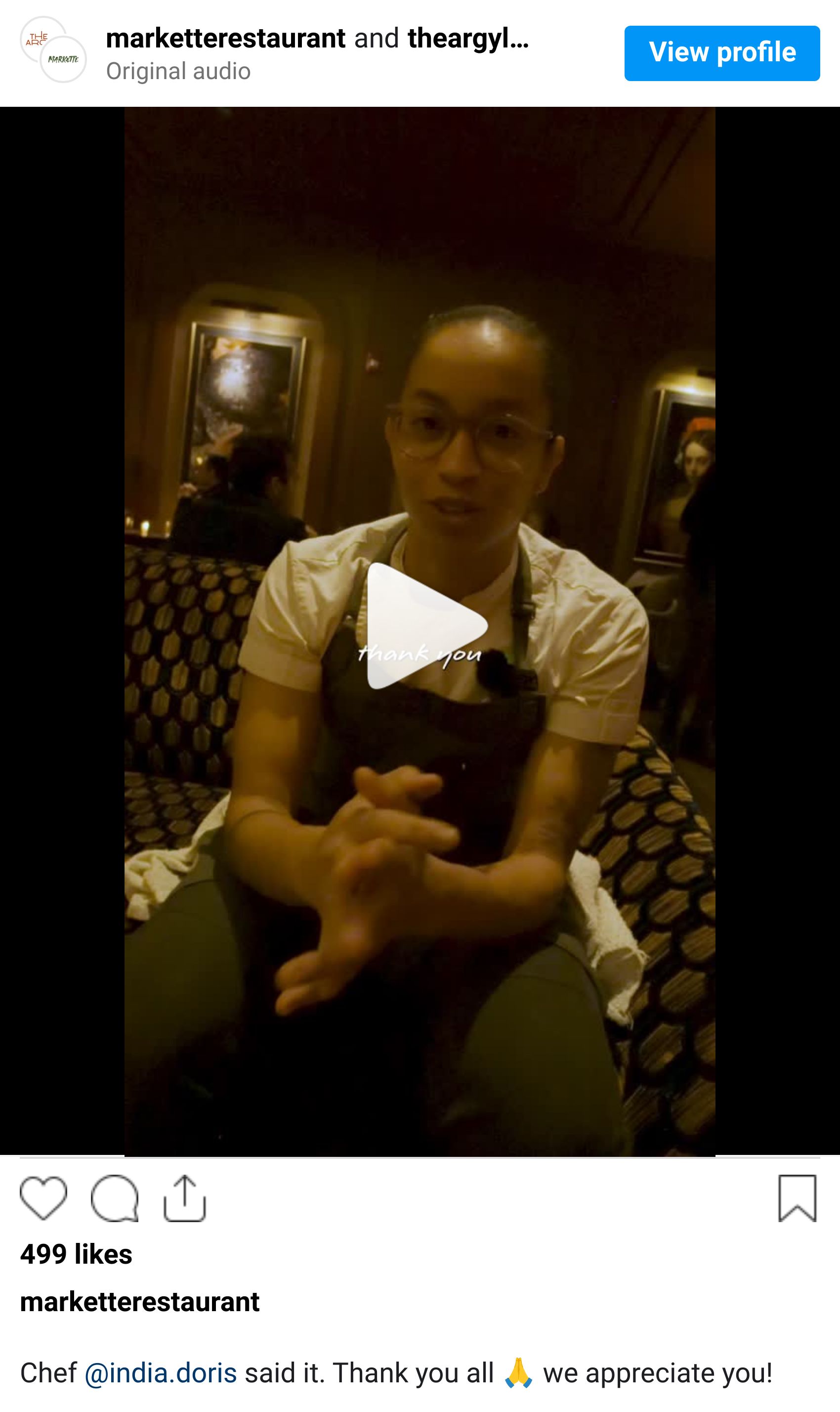
“It’s been super busy. We’ve had people waiting outside,” she says in the video. “I’m super grateful for that and the community behind it. It’s obviously so incredible to see. I’ve never seen anything that has brought people together so much.” She then asks folks who haven’t been able to get in, to DM and get in touch. “We want you to come in and hang with us here.”
There’s something very genuine about this response, which aligns with India’s approach to social media. While Markette is a fine-dining spot, their social media posts are welcoming and laid-back and bring diners inside the kitchen. (I wrote about this trend last week.)
When I spoke to India last year for Nation’s Restaurant News’ Extra Serving podcast, I asked her about her approach to social media, specifically how she highlighted her employees.
“It’s 100% intentional,” she said. “I know it’s just social media, but I think all the little things matter.” She recalled being recognized years ago at a kitchen equipment store while working for the late James Kent, after he had highlighted her work on social media. “It makes a difference, you know, to build this community, and makes you think that you’re part of something really special.”
Thank you, India, for sharing your story.
Side Dishes:
Tension between local restaurants and out-of-state restaurant groups and chains is rising in Nashville. “Real estate is increasingly being owned by companies rather than individuals,” AG Granderson of Nashville-based Make A Play Hospitality told The Tennessean.
A dose of reality from Portland, Oregon, to counterbalance the typical restaurant-month coverage: “By the end of the month, the whole staff is so burned out on cooking and serving the same thing over and over and over again,” Jacqueline’s Derek Hanson told The Oregonian. “My entire crew moaned when I told them I was considering doing it this year.”
This exhaustive study into Denver’s restaurant industry had some grim findings. Specifically, when the study’s authors compared Denver restaurants to their non-Denver counterparts run by the same brands and restaurant groups, the non-Denver restaurants were doing much better financially. PDF of the full study here.
What do the layoffs at Block (the parent company of Square) mean for restaurants? For one thing, the former Head of Food & Beverage at Square is “unexpectedly now just a restaurant operator with restaurants that use Square.”
One knock-on effect of the New York Times’ investigation of abuse at Noma is the renewed conversation about unpaid labor. As one fine-dining chef in New York tells me, “It’s difficult for new chefs to imagine a world where we can still become the best in the world, especially with all the labor laws now in place. Most of the best restaurant business models were built and dependent on free labor. I support the new labor laws; it’s just an unrealistic expectation to run restaurants the way they were run before, where ratios were five employees for each guest.”
Front of House:
At The Argyle, the cocktail lounge below Markette, I was charmed by the PB & J Sazerac served in this delightful glass.

“Ahhh Nuts!”
Thank you so much for reading In the Weeds.
If you enjoyed this newsletter, please forward it to a friend in the industry.
In the Weeds wants your feedback. I’d love to hear from you.
—gloria